




nothing like water
OUR IMPACT
Access to water and water balance
Access to drinking water is a primary asset that is essential for human health and wellbeing, but even today, unfortunately, many communities around the world cannot rely on clean water sources.
For this reason, in 2023 we began a water balance action in collaboration with the NGO The Sumba Foundation. On the one hand, we balance the water consumption of the production of our garments and the materials needed to make them; on the other hand, we make a tangible contribution to bringing drinking water to numerous villages on the island of Sumba, Indonesia.
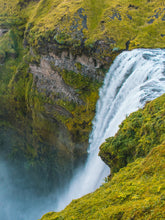

The Sumba Foundation
Providing access to drinking water is by far the most important and consolidated programme undertaken by The Sumba Foundation. Our project with the Foundation represents an important step to help the populations of Sumba to rise up from poverty and improve their sanitation conditions.
Through the construction of water pumps and wells, we are able to provide many families with access to water, saving women and children from having to travel tens of kilometres every day to reach the nearest source.
Through collaboration, we want to help create sustainable economies to improve the living conditions of Sumba communities, while respecting their cultural traditions.
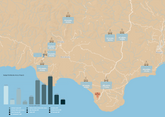
Water projects in Sumba*
PALAMOKO
In Palamoko, access to clean water has become a reality for 967 people. Over the course of just 7 months, a fully functioning water supply system was completed, transforming everyday life across 7 villages and 3 schools by providing a reliable source of running water where none had existed before.
The project involved the construction of 1 well, 2 main reservoirs, 7 water tanks, and 15 communal water stations, connected through 6,000 meters of piping. To power the system, an electricity house and power poles were built on-site, enabling the consistent operation of pumps and water distribution across the area.
Today, students at the local kindergarten, primary, and junior high schools benefit from access to running water—an essential step toward better hygiene and sanitation. Local maintenance teams have been trained to manage and sustain the system, ensuring long-term access for the entire community.
UBU MALEHA (WELIBO)
What was once an abandoned water system in Welibo village is now a vital source of clean water for 945 people. The Ubu Maleha Water Project, completed between August and November 2024, brought new life to old infrastructure and delivered a practical solution to daily water scarcity.
The most meaningful impact has been at SDI Welowa (Welowa Primary School), where 121 students and 11 teachers now have reliable access to water throughout the day. Two restrooms and two handwashing stations were added, improving hygiene conditions and supporting a healthier learning environment.
The revitalized network includes 1 well, 1 reservoir, 5 distribution tanks, and 16 communal water stations. It also integrates functional parts of the old system—such as the Watu Harangi spring, the Hobarata reservoir, and several existing tanks and public stations in nearby areas—creating a connected and resilient water supply.
WELAGAYA (WELIBO)
Completed in September 2024, the Clean Water Program in Welagaya has successfully provided safe, reliable water access to 432 residents in Tanakaka Village, including students and teachers from Primary and Middle Schools.
As part of the project, three school toilet facilities and two handwashing stations—one per school—were installed, significantly improving hygiene conditions and supporting a healthier learning environment for both students and staff.
The new infrastructure includes 1 well, 3 water tanks, and 4 communal water stations, all connected through a pipeline running from Welagaya Spring to the schools and the surrounding village. Despite heavy rainfall and initial concerns from some community members, the system was completed on schedule and is now fully operational.
WE MORO (WELIBO)
Between July and November 2024, the We Moro Water Project delivered clean water access to 475 residents across multiple villages in Desa Welibo, including students and school staff.
The project involved the construction of 1 well, 5 water tanks, and 14 water stations, supported by a 5,750-meter piping network. Despite delays caused by seasonal drought and traditional local ceremonies, the full infrastructure was completed as planned.
A key improvement was the adjustment of the flow system to ensure a steady and reliable water supply, even during dry periods. Local maintenance teams were also trained to manage and sustain the system independently.

Weluri Kalla Project: Originally discontinued in 2013, the Weluri Kalla Project has been revitalized with our support and the recent addition of an electricity grid in the area. This development allows for the resumption of pump construction, set to supply drinking water to the historic hillside villages.
In total, 3.500 meters of piping have been installed, connecting to four existing fiber tanks (each with a capacity of 2.300 liters) and one reservoir of 2.000 liters. This extensive network now serves 1.037 individuals across 148 households, including a primary school and a kindergarten, spanning 11 villages. In the second phase, one additional fiber tank with a capacity of 2.300 liters and another with 3.200 liters were installed, further expanding access to clean water in these communities.
Malisu Village Project: This project centers on constructing an electric
pump and well at the existing water source near Malisu village. With our
support, significant enhancements were made, including the installation of two
2.300-liter fiber tanks and four faucets, bringing clean water directly to 216
individuals across 28 households. This project has notably transformed the
lives of the community's women and children, who previously endured long walks
just to collect a single bucket of water.
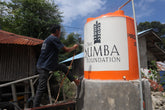
Pahola Water Project: Our contributions have enabled the installation of
three fiber tanks, each with a 5.300-liter capacity, and seven water taps. This
water project now supports a village of 396 people and an elementary school
with 194 students. By providing essential access to clean water, we're making a
substantial difference in the lives and health of both the community and its
younger members.
Waimadaka Water Project: Our project has achieved a significant milestone, providing a reliable
water supply to 627 individuals. This includes 156 primary school students, 161
junior high school students, and 310 residents from surrounding villages. To
ensure easy access for the community, we've installed two hand pumps at the
well and an additional pump at a nearby well.

Hobawawi Water Project: Concluding in early November 2023, the Hobawawi Water Project benefits 603 people. This initiative involved upgrading the electricity cables and constructing two communal water stations, thereby improving the infrastructure and access to essential resources.
Watukarere Water Project: Completed in September 2023, the Watukarere Water Project introduced two fiber tanks (5.300 and 2.300 liters) and seven water stations, significantly enhancing clean water access for 310 people in the area.
Praimodu Water Project: The Praimodu Water Project was successfully completed at the end of November 2023. Two fiber tanks, each with a capacity of 2,300 liters, were installed alongside four communal water stations. This project has provided clean water access to 107 residents across three different villages.
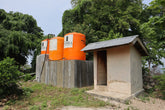
Pakat Water Project: Completed at the end of November 2023, the Pakat Water Project saw the installation of three fiber tanks—one with a capacity of 5,300 liters and two with 2,300 liters each. Additionally, a genset house and a reservoir were constructed, complemented by four communal water stations. This development now serves 151 individuals from two villages, marking a crucial step toward water access.
* Updated on 15/05/2025